The near and far transfer effects of computerized working memory training in typically developing preschool children: Evidence from event-related potentials
Working memory (WM) refers to the ability to actively maintain and process information needed to complete complex tasks such as comprehension, learning, and reasoning. Recent studies have examined the efficacy of computerized working memory training (WMT) in improving cognitive functions in general and WM in particular, with mixed results. Thus, to what extent can WMT produce near and far transfer effects to cognitive function is currently unclear. This study investigated the transfer effects of a computerized WMT for preschool children and also examined the possible neural correlates using the event-related potential (ERP) technique. A total of 50 Chinese preschoolers (64.44 ± 7.76 months old; 24 girls) received 4-week training during school hours. Compared with those in the active control group, children in the training group showed better gains in behavioral performance in the WM task and significantly more changes in ERP markers of the WM and inhibitory control tasks (near transfer effect). However, no evidence was found for transfer to fluid intelligence (far transfer effect). These findings suggest that WMT is capable of enhancing cognitive functioning in preschool children, and as such this work has important implications for educational practice and it may help to design and refine cognitive interventions for typically developing children and those with WM problems or other cognitive deficits (e.g., children with attention-deficit/hyperactivity disorder).
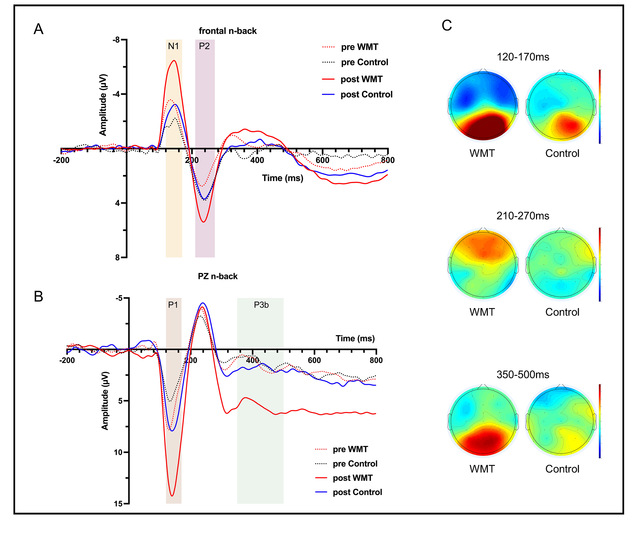
图1. 前后测任务中1-back任务的波形和地形图。(A)额叶区FZ、FCZ、F3、F4、FC3和FC4的平均波形图;(B)顶叶区Pz点波形图;(C)训练组与对照组在三个时间窗中差异(测试后减去测试前)的地形图。WMT:工作记忆训练。
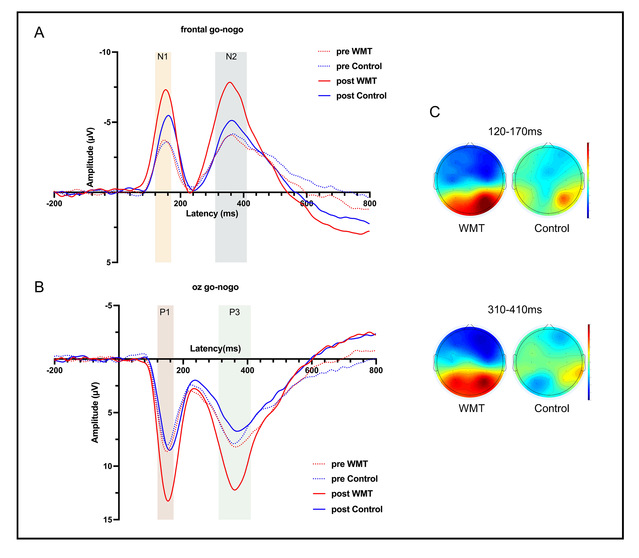
图2. 前后测任务中go-nogo任务的波形和地形图。(A) 额叶区FZ、FCZ、F3、F4、FC3和FC4的平均波形图;(B)枕叶区Oz点波形图;(C) 训练组与对照组在两个时间窗中差异(测试后减去测试前)的地形图。WMT:工作记忆训练。
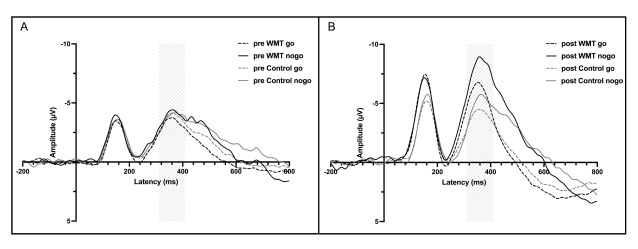
图3. 前后测任务中go-nogo任务的N2效应。(A)前测;(B)后测。WMT:工作记忆训练。
新闻稿链接:

 The near and far transfer effects of computerized working memory training in typically developing preschool children.pdf


