Improving Fluid Intelligence of Children through Working Memory Training: The Role of Inhibition Control
Lei Wang, Ang Sheng, Lei Chang, Renlai Zhou
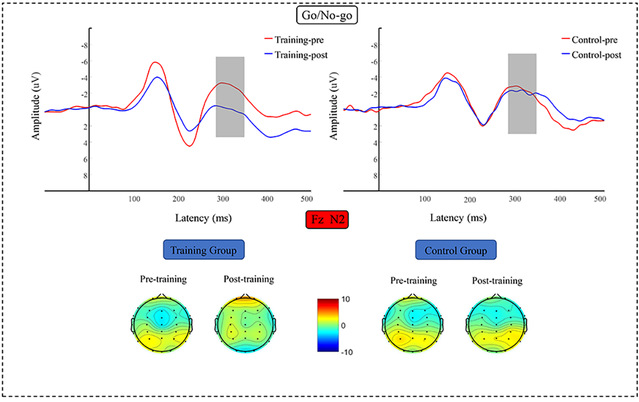
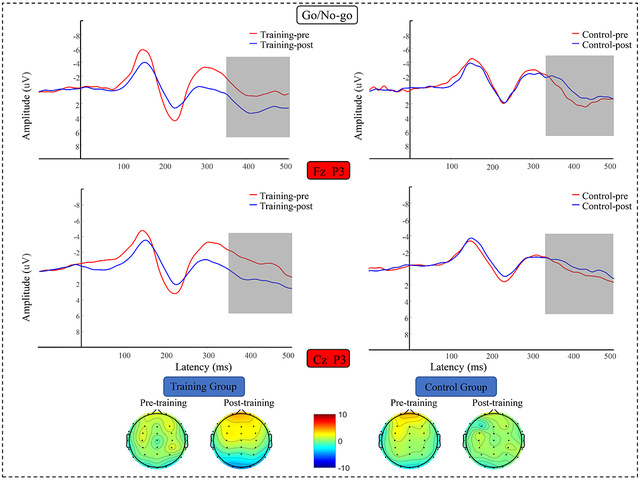
Intelligence is strongly associated with working memory. Working memory training can improve fluid intelligence, but the underlying mechanism requires further investigation. Because inhibition control may play a key role in working memory training, this study investigated this process from an electrophysiological perspective. In total, 40 children aged 9 to 11years were enrolled and randomly divided into a training group (n=20) and a control group (n=20). The training group received 20days of working memory training,whereas the control group did not receive any training. Before and after the training period, all participants were tested using Raven’s Standard Progressive Matrices (RSPM), and electrophysiological indicators were recorded while they performed go/no-go and Stroop tasks. The results revealed that relative to the control group, the training group had significantly improved RSPM scores in the test conducted after their training. For the go/no-go tasks, the training group exhibited a significant decrease in N2 amplitude, a significant increase in P3 amplitude, a significant decrease in theta band energy, and an improvement in response inhibition ability. No significant change was observed for the Stroop task. Correlation analysis revealed that an improvement in individual response inhibition can positively predict an improvement in fluid intelligence. These results suggest that working memory training enhances the fluid intelligence of children by enhancing their response inhibition ability.
 Improving Fluid Intelligence of Children through Working Memory Training The Role of Inhibition Control.pdf


