Plos One, 2012, 10.1371/journal.pone.0052160
Effects of head-down bed rest on the executive functions and emotional response
Qing Liu 1 Renlai Zhou1,2 Shanguang Chen 3 Cheng Tan 3
1Beijing Key Lab of Applied Experimental Psychology, School of Psychology, Beijing Normal University, Beijing, China
2State Key Laboratory of Cognitive Neuroscience and Learning, Beijing Normal University, Beijing, China
3China Astronaut Research and Training Center, Beijing, China
Abstract: Prolonged bed rest may cause changes in the autonomic nervous system that are related to cognition and emotion. This study adopted an emotional flanker task (Figure 1) to evaluate the effect of 45 days -6° head-down bed rest (HDBR) on executive functioning in 16 healthy young men at each of six time points: the second-to-last day before the bed rest period, the eleventh, twentieth, thirty-second and fortieth day during the bed rest period, and the eighth day after the bed rest period. In addition, self-report inventories (Beck Anxiety Inventory, BAI; Beck Depression Inventory, BDI; Positive Affect and Negative Affect Scale, PANAS) were conducted to record emotional changes (Figure 2), and the participants’ galvanic skin response (GSR), heart rate (HR) and heart rate variability (HRV) were assessed as measures of physiological activity (Table 2). The results showed that the participants’ reaction time on the flanker task increased significantly relative to their responses on the second-to-last day before the period of bed rest (Table 1), their galvanic skin response weakened (Figure 4) and their degrees of positive affect declined (Figure 3) during the bed rest period. Our results provide some evidence for a detrimental effect of prolonged bed rest on executive functioning and positive affect. Whether this stems from a lack of aerobic physical activity and/or the effect of HDBR itself remains to be determined.
Keywords: Head-down bed rest; Weightlessness; Executive function; Galvanic skin response; Heart rate variability
45天-6°头低位卧床实验对个体执行控制能力和情绪的影响
刘卿1,周仁来1,2,陈善广3,谈诚3
1北京师范大学心理学院应用实验心理北京市重点实验室北京 100875
2北京师范大学认知神经科学与学习国家重点实验室北京 100875
3中国航天员科研训练中心航天医学基础与应用国家重点实验室北京 100094
摘要:本研究采用Flanker任务(Figure1),考察了16名健康男性(20~34岁)被试在45天-6°头低位卧床模拟失重条件下,卧床前2天,卧床第11天、第20天、第32天、第40天和卧床后8天执行控制能力的变化趋势,以情绪自评来记录被试情绪的主观体验,以皮肤电反应、心率和心率变异性等指标来反映被试情绪的生理变化。研究结果发现,与卧床前2天相比,被试在卧床期间(卧床第11、 20、 32和 40天)执行Flanker任务的反应时显著增加(Table1),皮肤电反应显著减弱(Figure4),心率降低(Table2),正性情绪下降(Figure3);心率变异性的结果显示,与卧床2两天相比,被试的心率高频(HF)值在卧床第32天和卧床后8天显著下降;BDI、BAI结果表明整个卧床期间被试并未表现出临床上的焦虑和抑郁情绪(Figure2)。研究表明,-6°头低位卧床模拟失重条件会对个体执行控制能力产生损伤,同时影响情绪和生理活动,表现为反应时显著增加、正性情绪显著下降和皮肤电反应显著减弱。
关键词:头低位卧床;失重;执行控制;皮肤电反应;心率变异性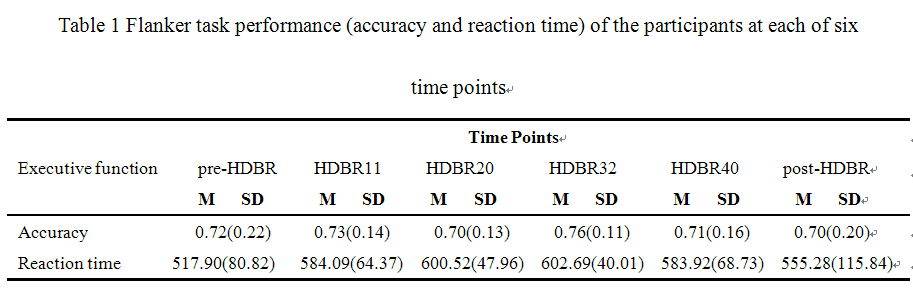
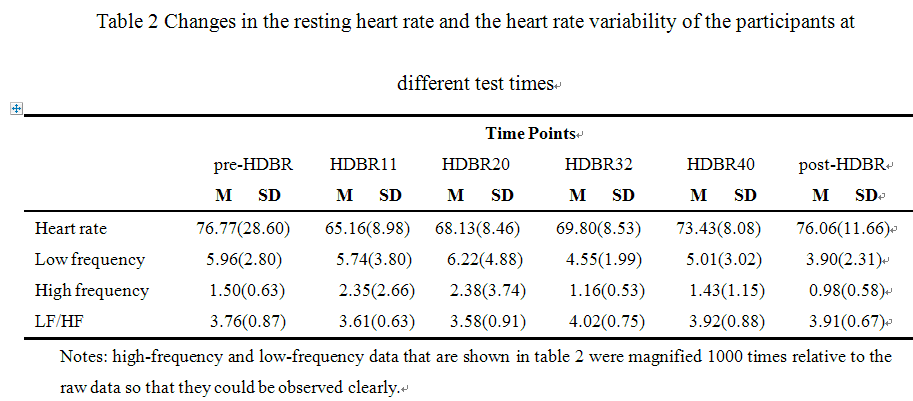
Notes: high-frequency and low-frequency data that are shown in table 2 were magnified 1000 times relative to the raw data so that they could be observed clearly.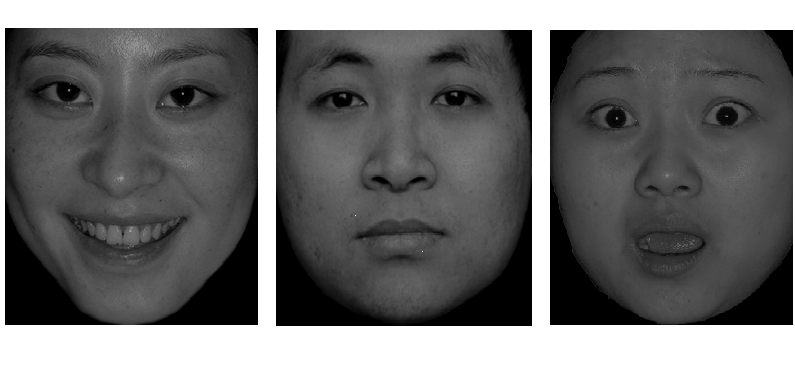
Fig 1.Emotional picture samples (happy, neutral and fear)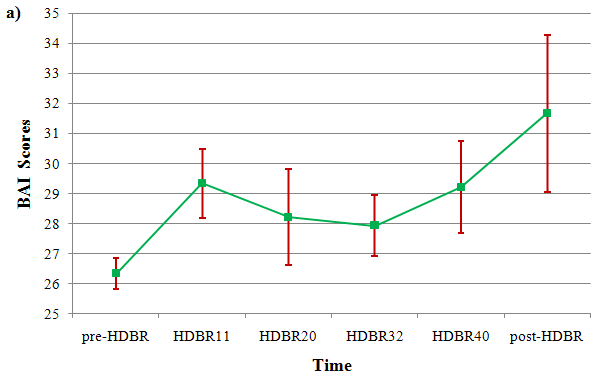
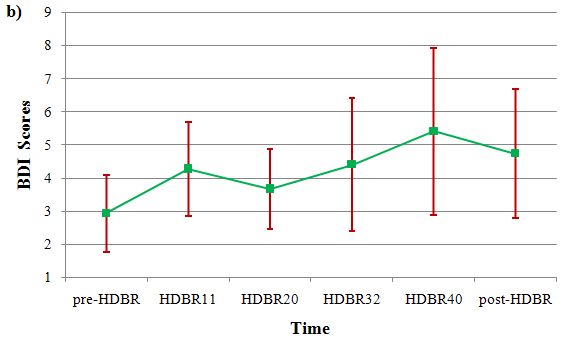
Fig 2.Participants’ Beck Anxiety Inventory (BAI) and Beck Depression Inventory (BDI) scores at different time points. a) Participants’ performance on BAI at six time points (pre-HDBR, HDBR11, HDBR20, HDBR32, HDBR40, post-HDBR). b) Participants’ performance on BDI at six time points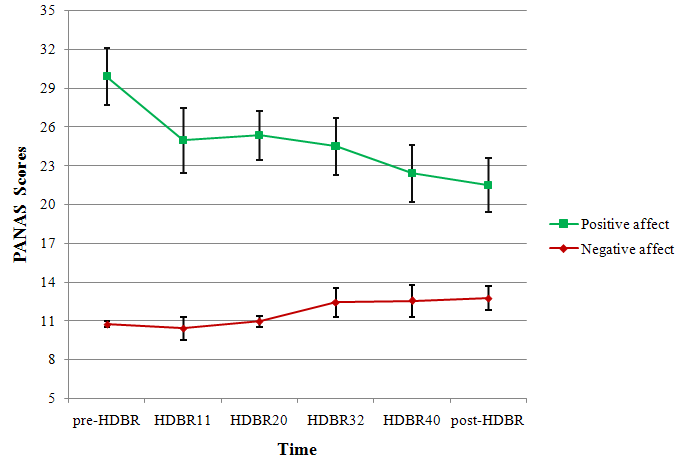
Fig 3.Participants’ positive affect and negative affect scores at different time points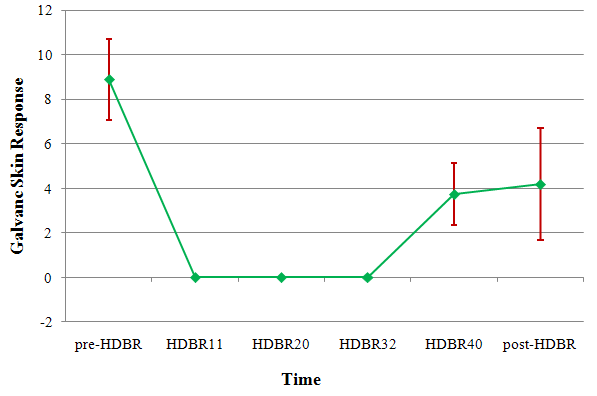
Fig 4.Galvanic skin response of the participants at different time pointsNotes: The mean values of different time points (pre-HDBR, HDBR11, HDBR20, HDBR32, HDBR40, and post-HDBR) were 8.89, 0.012, 0.015, 0.015, 3.75 and 4.19µmho.


