The dysregulation of top-down control in individuals with high test anxiety_ A resting state fMRI study
Background: Individuals with high test anxiety (HTA) have deficits in attentional control and in stress responses when faced with tests. However, little is known about the underlying neural mechanism. Anterior cingulate cortex (ACC) is involved in both attention and emotion networks, therefore this study examined the neural functional dysregulation in test anxiety from the perspective of functional connectivity (FC) using bilateral ACC as the regions of interest.
Methods: Fifty-one participants were divided into HTA (n = 23) and low test anxiety (LTA, n = 28) group according to their Test Anxiety Scale (TAS) scores. Brain imaging data in resting, preparing, and recovering phases of a modified social evaluative threat task were collected, and emotional changes were assessed.
Results: Compared with the LTA group, the HTA group exhibited significantly lower FCs between the ACC and superior frontal gyrus (SFG) in all 3 phases, significantly lower FCs between the ACC and inferior parietal gyrus (IPG), and significantly higher FCs between the ACC superior temporal gyrus (STG) in the preparing phase. Moreover, in the HTA group, the resting state IPG-ACC FC was associated with their TAS score, the preparing state STG-ACC FC was associated with the increased anxiety.
Conclusions: Individuals with HTA have general prefrontal control deficits. When facing a test, they tend to recruit more resources to deal with high emotional interference. The dysregulated control of the ACC by the frontal-parietal network may underlie the pathophysiology of test anxiety.
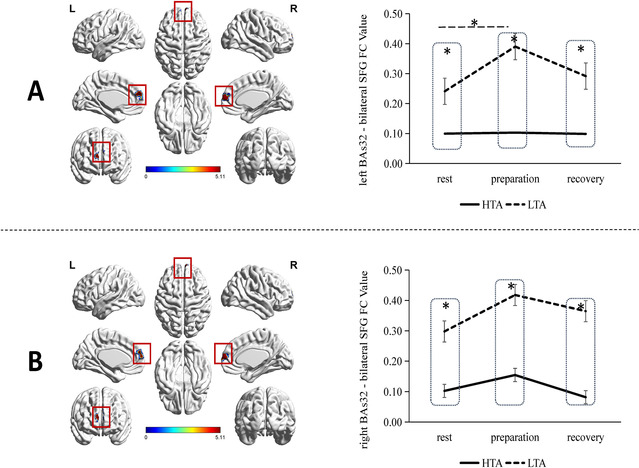
Fig. 2. A: SFG clusters of significant FC with the left BAs32 involved in TA (left), and the interaction effect between group and phase on the FC (right); B: SFG clusters of significant FC with the right BAs32 involved in TA (left), and interaction effect between group and phase on the FC (right).
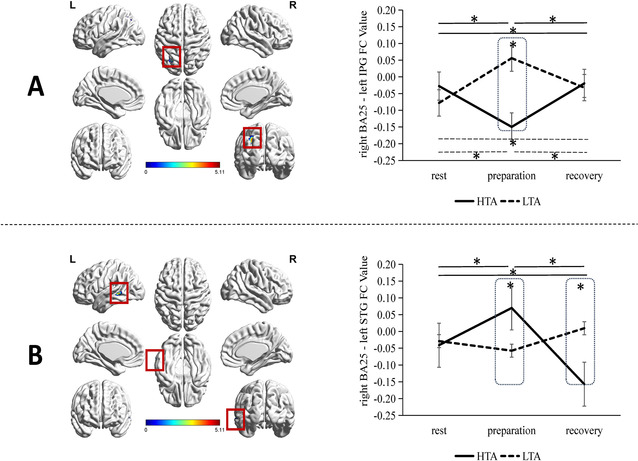
Fig. 3. A: IPG clusters of significant FC with the right BA25 involved in TA (left), and the interaction effect between group and phase on the FC (right); B: STG clusters of significant FC with the right BA25 involved in TA (left), and the interaction effect between group and phase on the FC (right).
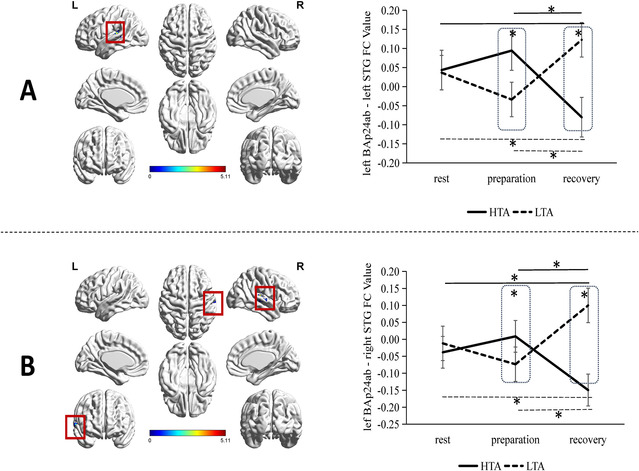
Fig. 4. A: left STG clusters of significant FC with the left BAp24ab involved in TA (left), and interaction effect between group and phase on the FC (right); B: right STG clusters of significant FC with the left BAp24ab involved in TA (left), and interaction effect between group and phase on the FC (right).
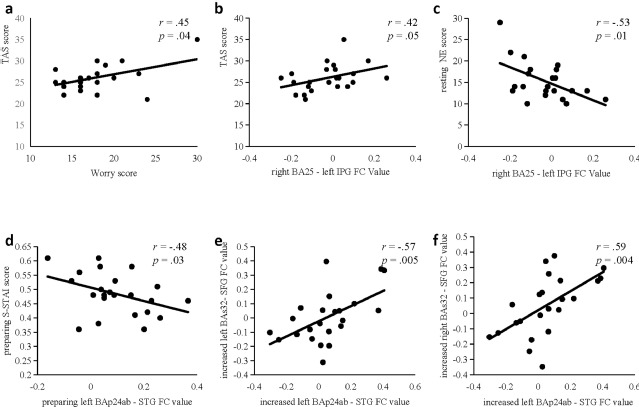
Fig. 5. Scatter plots of the Pearson correlations among FCs, TA and emotional state in the HTA participants.


